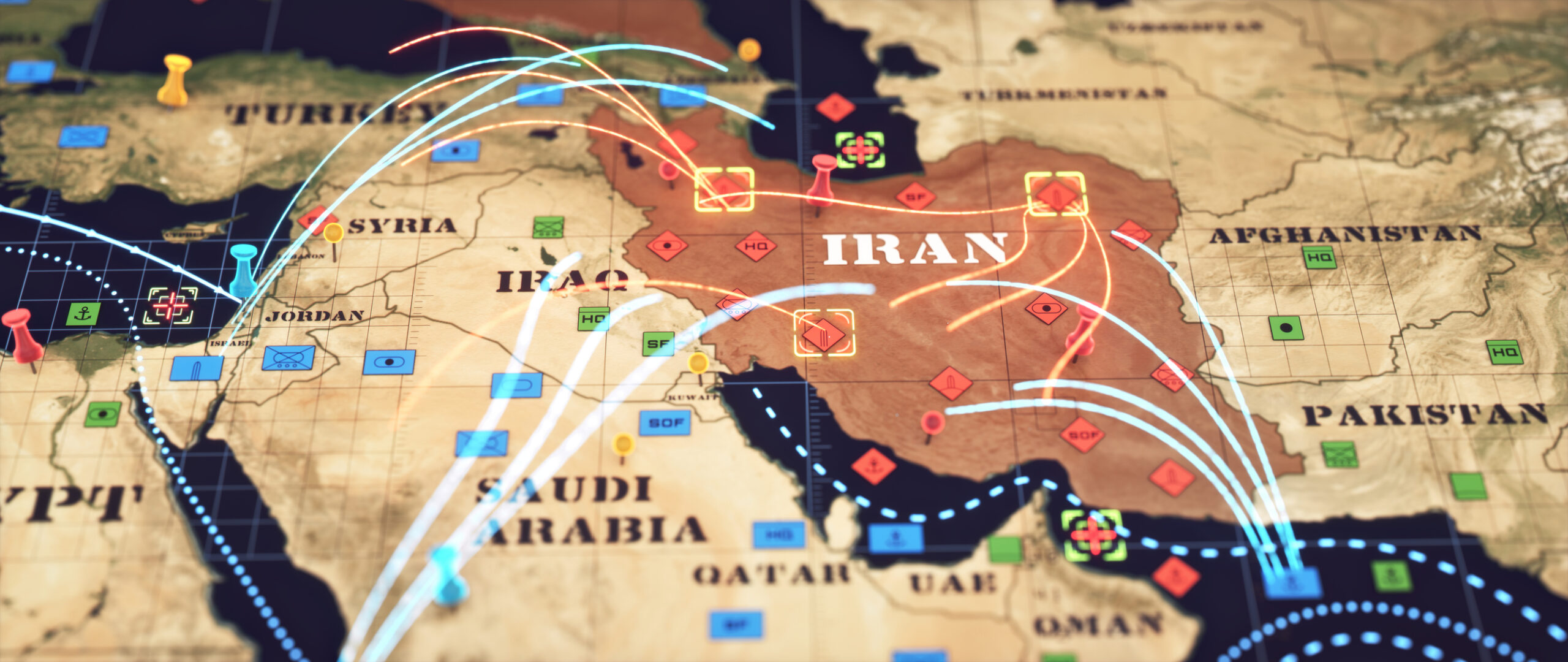
On February 28th, America and Israel once again used the cover of diplomatic negotiations to launch an unprovoked and unjustified attack on Iran. On a superficial level, this latest round of violence appears to be repeating and entrenching patterns set in motion decades ago when the US first established itself as the dominant military power in the Middle East. However, Iran’s forceful response suggests America and Israel may have bitten off more than they can chew. The implications of their overreach could reshape the region’s entire geopolitical landscape.
To understand why requires understanding America’s political objectives and why they are no longer feasible. These have been framed as preventing Iran from developing a nuclear bomb, degrading its missile and drone capabilities, instituting regime change, and even “liberating” the Iranian people. These explanations are best characterized as either tactical goals or propaganda that have little connection to America’s overarching strategic objectives. America’s goals are not simply to degrade Iran’s military capabilities and they clearly have nothing to do with helping Iran’s people. Its goals are to maintain its control over the entire region while simultaneously ensuring apartheid Israel’s dominance by destroying the only state willing to openly defy it.
Viewed in this context, the conflict with Iran is merely the latest battle in a campaign that began in earnest with the first Persian Gulf War, expanded during the so called “War on Terror” and included the destruction of Iraq, Syria, Lebanon, Libya, Yemen, and Sudan. At its core, America’s strategy is primarily based upon ensuring the region is ruled by inherently weak dictatorships or failed states that are incapable of challenging its military primacy or Israeli hegemony.
TACTICAL AND STRATEGIC OVERVIEW
Iran responded to the joint American-Israeli assault by launching thousands of missiles and drones at targets in Israel and American military installations located in allied Arab countries throughout the region. It then expanded these attacks to include regional energy infrastructure after its energy facilities were attacked. These strikes destroyed or damaged several important energy production sites as well as radars, communications nodes, and intelligence facilities used to track and shoot down its ballistic missiles and drones while also forcing its adversaries to deplete their stocks of air defense missiles.
Iran’s attacks have been particularly painful for America’s partners in the Arab world. They have shattered the image of Gulf Cooperation Council (GCC) states as an oasis of calm in an otherwise turbulent region, degraded important energy infrastructure and caused sever economic disruptions that will have long lasting effects. According to a report by Al Jazeera, GCC nations and Iraq face the prospect of significant drops to their GDPs and oil revenue that will only get worse as the conflict drags on.
They have also exacted a heavy toll on America’s military infrastructure and equipment. Several high-value radar installations costing billions of dollars have been destroyed and satellite images show many of its bases have suffered significant damage. America has also lost three F15 fighter jets, 12 reaper drones, an E3 AWACS aircraft, and one KC-130J refueling tanker while a massive fire on the USS Ford forced it to withdraw from the fight. Iranian missiles also damaged several KC-130Js and an F-35. 13 American troops are confirmed dead and roughly 200 have been injured. Israel’s censors and a compliant Western media have prevented an objective assessment of the damage it has sustained; however, videos circulating on social media indicate its vaunted air defenses have been routinely penetrated by Iranian missiles and that several of its tanks have been destroyed in Lebanon.
Most importantly, Iran has effectively closed the Straits of Hormuz, a vital passageway for 20% of the world’s energy supplies. These actions sent oil prices soaring from $67 a barrel to over $100 but these figures are nothing compared to the impact on energy prices if the Houthis close the Red Sea to shipping. Though they have yet to fully join the fight, they have quietly built a force of 350,000 troops that would allow them to wreak havoc should they decide to do so.
Military strategists often talk about destroying an enemy’s “center of gravity” as the surest means to victory. America’s penchant for decapitation strikes reflect its attempts to follow this maxim. In this war, the Straits represent America’s and the GCC’s center of gravity. Iran’s closure of this passage therefore represents a crucial blow against America and its allies. Iran, on the other hand, has developed a “mosaic” defensive posture that contains no center. Its military consists of 31 different operational commands, each capable of fighting independently.
The closest thing Iran has to a center is Kharg island but taking it would most likely involve sailing an amphibious force through the Straits and up the entire length of the Persian Gulf which would expose it to coastal batteries, kamikaze drones, and mines. Even if such a force arrived intact and took the island, the ships needed to keep it supplied would have to make this same journey. An assault involving paratroopers would run into similar logistical issues. In other words, Iran’s center is well protected and unlikely to fall while America’s has already been taken.
Despite absorbing thousands of strikes and sustaining heavy casualties, Iran continues to defy two of the most powerful militaries on Earth, all while keeping deadly assets like the Houthis in reserve. Its strategy has created the risk of a global recession while exposing the fundamental contradictions that govern the region’s US imposed security architecture by showing it has made the Arab states that invested billions to build it less secure.
The Trump administration is so desperate, it is openly contemplating using ground troops and proxies to secure the objectives its air campaign failed to achieve. It is also asking other nations to help it lift Iran’s blockade of the Straits and even removed sanctions on Russian and Iranian oil in an attempt to stabilize energy prices. Despite these early successes, it is still too early to tell whether Iran’s government can maintain its resistance in the face of the devastating attacks it has endured.
The true test will come over the next few weeks and months. Once Israeli, American, and Arab air defense ammunition stockpiles are sufficiently depleted, Iran will be well-positioned to inflict significantly more damage, assuming it still has enough drones and missile launchers. If it is able to do so, even Israel’s censors will have a hard time hiding the results. More importantly, if it can maintain the closure of the Straits for an extended period of time, it will impose significant costs on America and its allies.
America’s military posture in the Middle East has always been unsustainable and doomed to end ignominiously. Its military presence is designed to protect a violent apartheid state and relies on brutal Arab dictatorships to sustain itself, but these allies are the primary cause of the region’s instability. As a result, protecting them has trapped America in a quagmire of its own making.
Iran’s attacks are merely exposing the fragility that comes with pursuing unrealistic imperial ambitions thousands of miles from home. Compounding the issue, America is nearly $40 trillion in debt (a significant portion of which was accumulated in pursuit of those aforementioned imperial ambitions) and simply cannot afford to expend more resources on the Middle East, let alone a protracted war. The cascading impact of rising energy prices will only make its position more precarious. Combined, these factors will place the US in an increasingly untenable position, one that could lead to defeat and its military withdrawal from the entire region.
IRAN IS IN A LOSE-LOSE SITUATION
Unfortunately for Iran, the prospect of victory brings its own peril. Instead of allowing Iran to defeat them, the evil people who rule Israel and America could very easily use nuclear weapons against it. Both nations are led by war criminals and sociopaths who already have the blood of hundreds of thousands of innocent people on their hands. Donald Trump spent his first term in office helping Saudi Arabia murder nearly 400,000 people in Yemen. His ally, Israeli Prime Minister Benjamin Netanyahu is wanted for war crimes relating to the genocide he unleashed in Gaza that killed at least 70,000 people including 20,000 children.
Some might believe that no rational person would use nuclear weapons absent an existential threat since doing so would make Israel far less safe over the long run. Aside from unleashing poisonous radioactive fallout, using such weapons would inevitably lead to their proliferation across the region and would likely culminate in mushroom clouds over Tel Aviv and Haifa one day.
The problem is that the men in charge of America and Israel are not rational people. They have no morals, empathy, or sense of honor which makes them perfectly capable of doing evil and barbaric things, like dropping nuclear bombs on Iran for having the audacity to defend itself from their hypocritical and completely unjustified violence. Instead of admitting defeat, they are far more likely to commit unspeakable horrors if they calculate doing so will allow them to save face.
Whereas success on the battlefield could trigger a nuclear reprisal, defeat could lead to decades of chaos and anarchy. If America and Israel manage to re-open the Straits and neutralize Iran’s drones, missiles, and air defenses, they will likely spend several months bombing the country’s political, economic, and military infrastructure and institutions while arming separatist groups and factions throughout it. This could plunge Iran into a civil war that last decades, turning it into a failed state like Libya or Yemen. In either case, millions of innocent Iranians will die.
In summary, America and Iran are on the precipice of disaster and they are poised to drag the rest of the region and possibly the world down with them. Both desperately need a way to pull back but neither seems capable of devising a practical way to do so. America’s leaders are still clinging to the fantasy that they can prevent Iran from developing nuclear weapons but Iran’s ability to dismantle its military infrastructure and block energy and trade arteries suggests those days are over. Whereas Gaza revealed America’s and Israel’s brutality and racist hypocrisy, the war against Iran has revealed their vulnerability and the unsustainable nature of the region’s current military dynamics.
A WAY FORWARD
It is certainly possible Iran’s tenacious defense forces America and Israel to de-escalate, leading to an era of relative calm in the same way Hezbollah’s thrashing of Israeli forces in 2006 led to nearly two decades of calm in Lebanon. Even if they decide to unilaterally end their illegal war, it will not lead to a long lasting peace without a comprehensive political agreement that addresses the underlying issues driving this conflict.
The only way to do that is to build a new security architecture that allows America to withdraw its forces and end its toxic role in the region. The need to do so has been obvious for years. America’s first attack on Iraq and the sanctions regime that followed killed 1.5 million people. Its post 9/11 assault on the Muslim world killed another 4.5 million. When the toll from these crimes are added to the list of victims from its support for the Saudi war in Yemen and apartheid Israel’s genocidal violence, the total figure approaches 6.5 million people. The war on Iran, a nation of 92 million people, has the potential to add millions more to the list. The need to end America’s reign of terror has never been greater.
The only countries with the power to end it are Pakistan, Turkey, and Saudi Arabia. Though they are all aligned with America, they are also in grave danger due to its reckless actions and unequivocal support for apartheid Israel. America’s plans to arm Iranian Kurdish and Baloch separatist groups will inevitably cause chaos in Turkey and Pakistan. At the same time, Israeli leaders have begun openly identifying Turkey as a future strategic threat while Israel’s long-standing military cooperation with India raises serious concerns for Pakistan. Saudi Arabia is in even greater danger since much of its land has been earmarked for the Greater Israel project. Each of these nations has a vested interest in creating a new regional order capable of ensuring their long term security needs.
Thankfully, they already have the beginnings of a framework in place. Pakistan and Saudi Arabia entered into a formal defense treaty shortly after Israel’s attack on Qatar last year. Turkey has been in talks to join their pact and Iran has also expressed interest. Expanding it to include Turkey and Iran and adding an economic dimension in the form of a free trade agreement would create the foundation of a new system that could allow these core regional states to assume security responsibilities for the entire region. Donald Trump has good relationships with the leaders of all three nations and both Pakistan and Turkey have good working relationships with the Iranian government. As such, they are well-positioned to convince America to change course and create a new security paradigm capable of replacing it.
Whether they take the necessary steps will largely depend on Turkish President Erdogan, Pakistan’s Field Marshal Munir and, to a lesser extent, Saudi Arabia’s Muhammad Bin Salman. These three men hold the key to stabilizing the entire region but they can only do so by working together to devise a comprehensive solution that integrates Iran into a new regional order. The alternative is allowing this war to spiral out of control in a way that eventually consumes all their nations.