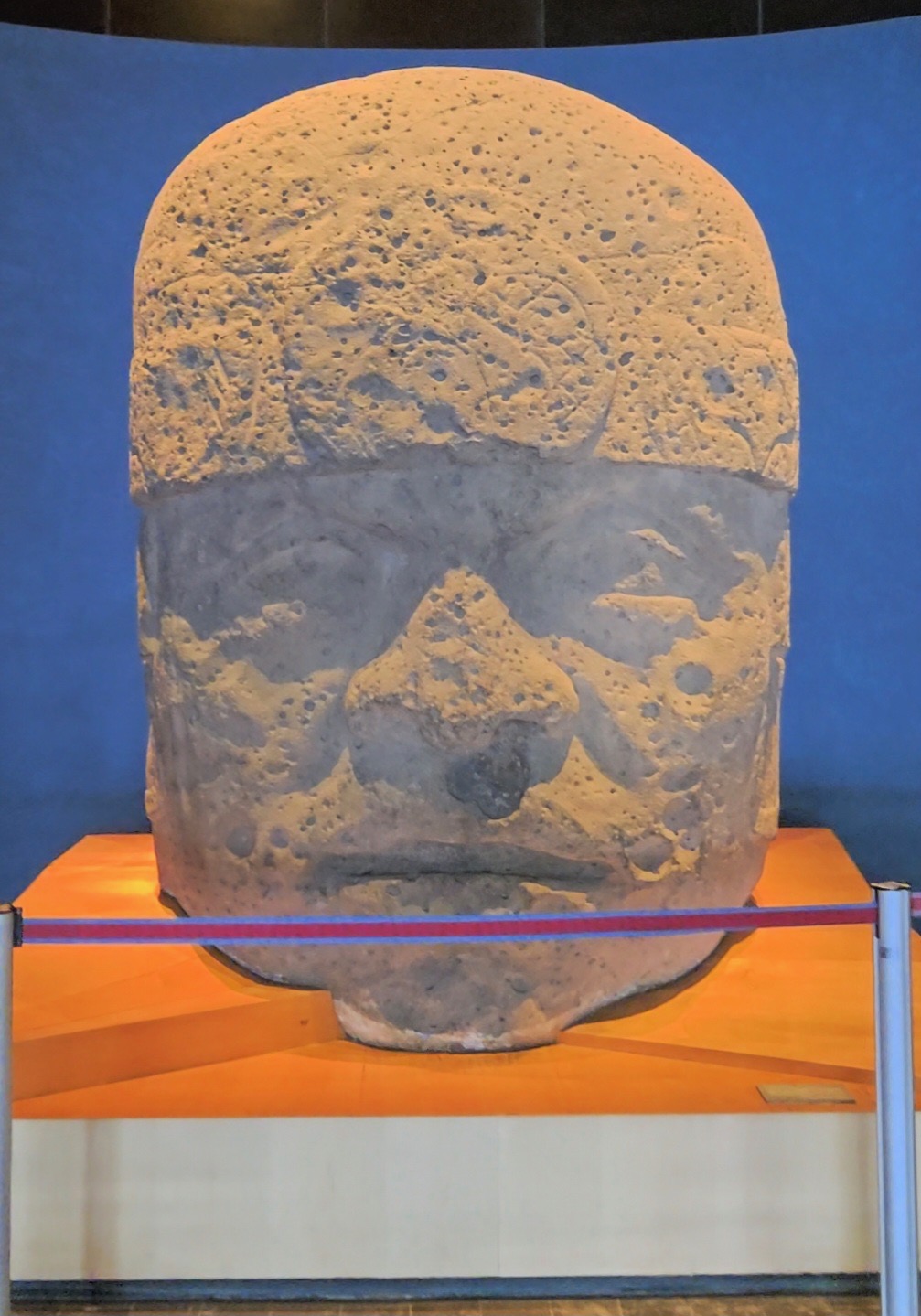
I recently spent a few days exploring Mexico City’s National Museum of Anthropology and the ruins of Teotihuacan about an hour north of the city. The museum has one of the most impressive collections of historical artifacts I have ever seen. Combined, the awe inspiring relics that fill its halls, like the massive stone heads of the Olmec or the Calendar Stone of the Aztecs, are evidence of complex and sophisticated civilizations that rose and fell over a period measuring thousands of years.
The city of Teotihuacan, for example, is estimated to be 2,400 years old and was once home to 200,000 people. Its largest pyramid, now known as the Pyramid of the Sun, is over twenty stories tall. Its design suggests its builders understood the mathematical relationship between the number 3.14 and the area and circumference of a circle, otherwise known as pi. By contrast, the supposedly more sophisticated mathematicians of Europe did not fully appreciate this connection until 1706, let alone incorporate it into their architecture.
In addition to exhibiting advanced building skills and mathematical knowledge, the city appears to have been part of a vast trade network that extended into South America since two of its buildings contain mica mined from Brazil. This implies the existence of well developed maritime links and cargo ships capable of navigating long distances since that is the only practical way to move bulky goods between Mexico and Brazil. It also contains countless workshops that were used to make a variety of goods such as obsidian and jade products, further reinforcing the argument it was a hub of commercial activity.
Mexico is a treasure trove of similar finds. There are countless other sites spread throughout the country and into Central America. The stories of the people, kingdoms, and empires responsible for these wondrous monuments must have been full of epic battles, political intrigue, and larger than life personalities, all driven by a complicated mix of political, strategic, idealogical, and religious considerations and beliefs.
Alas, these key details, and most of the 68 indigenous languages in which they were first shared, have been lost to the world. We do not even know the name of the people who built Teotihuacan, let alone their beliefs or the extent of their political control and economic influence. The modern day names of these sites and their structures mostly come to us from the Aztecs or Spanish.
That such a crucial part of the human story has been lost to us is unforgivable and shameful. It shows exactly what happens when the victors write the history books. Spain’s conquistadors and the Europeans who wrote about them made sure their accounts left out any details that might contradict their claims the people of these lands were brutal savages who deserved to die. To complete their coverup, Spanish friars spent the decades after the conquests collecting and burning nearly every piece of indigenous writing they could find while destroying innumerable priceless artifacts, making it impossible to learn about their victims or their history.
These crimes and the efforts to conceal them were not an isolated incident but part of a broader expansion of European power that began when Portuguese sailors built ships that allowed them to explore the coast of Africa. This led to what is described in Western history books as an age of “discovery,” when Europe’s nations began their bloody and violent conquest of nearly the entire planet. In addition to the Spanish, the English, French, Dutch, Portuguese, and Russians all invaded and conquered territory in the Western Hemisphere, Africa, Asia, Australia or Oceania. The Germans, Belgians, and Italians eventually joined in too.
Countless millions across the globe were murdered, raped, enslaved, or forced into poverty and destitution as a result of Europe’s imperial wars of conquest and the belief held by many Europeans that they alone have the right to rule the world and monopolize its wealth. Just as Mesoamerica’s history has been lost and buried, these stories have also been ignored or silenced.
The violence committed by Europeans in Africa was similar in scope and brutality to that inflicted in the Americas and has been minimized in much the same way. When the New York Post conducted a poll to compile a list of history’s most evil people, King Leopold II of Belgium did not even crack the top 25 despite turning the Congo into a tropical version of hell where he had at least ten million people murdered, tortured, mutilated, or enslaved so he could steal their resources.
The era of British rule over the Subcontinent has received similar whitewashing. Tucker Carlson described the British Empire as “far more humane than any other ever” while ignoring that it starved millions of Indians to death to ensure the East India Company and its shareholders could make a fortune selling Indian rice abroad. Those who participated in an uprising against British rule in 1857 were tied to cannons and executed by having holes blown through their chests at close range.
As Gaza shows, Western imperialists are still slaughtering those they deem inferior while simultaneously dehumanizing and silencing their victims. Though they still burn books on occasion, today’s imperial powers usually rely on more modern methods to control the narrative such as manipulating the editorial slants of their news outlets, banning social media platforms they cannot control like TikTok, murdering journalists reporting on their crimes, refusing to show movies that portray their victims as human, or arresting non-violent protesters like Mahmoud Khalil for daring to speak out against them. When these tricks fail, they simply create non-sensical labels like “terrorist sympathizer” to prevent meaningful discussions of their crimes. These tactics are all modern day versions of the bonfires lit by Spanish friars in the 16th century and show how little the West has evolved since then.
Our history has been manipulated not only to silence and marginalize but to demonize. Just as the savagery of the Aztecs was used to rationalize the crimes committed against the indigenous people of Mexico (many of whom were victims of the Aztecs), the savagery displayed by Hamas fighters on October 7th has been used to justify massacring tens of thousands of innocent Palestinians. Both narratives relied on racist tropes to excuse unspeakable violence while hypocritically ignoring the brutality of the narrators.
In a similar vein, the heirs to Europe’s imperial legacy often try to distract from their crimes against Muslim societies by pointing to Islam’s expansionist history. Aside from being irrelevant and illogical since no Muslim army has invaded a Western nation since the Ottomans tried to take Vienna in the 17th century, their argument ignores some basic facts. When the Arabs conquered the Middle East and North Africa, they did not burn the books of their victims or force their new subjects to convert. Instead, they created some of the greatest libraries the world has ever known to preserve and study their knowledge while guaranteeing freedom of religion for all. Without their open mindedness and intellectual curiosity, Aristotle’s ideas might have been lost and forgotten centuries ago. Similarly, Muslim traders from the islands that comprise modern day Indonesia “discovered” and traded with the people of Australia long before Cook stumbled upon it. However, unlike the English, these men did not unjustly claim Australia as their own or attack the aborigines to steal their land.
Islam may have spread, in part, through conquest but none of those wars resulted in the sort of genocides witnessed in lands conquered by Europeans. That is because Muslim armies were bound by Islamic rules of war that protected civilians. Western armies faced no such constraints. As a result, they developed disgusting concepts like “total war” or Israel’s “Dahiya Doctrine” that deliberately targeted women and children as part of their battle strategies.
I often talk about the Muslim world’s struggles with Western colonialism and imperial violence but seeing the extent to which Mexicans have struggled with these same evils reminded me this is a global fight. White men from Europe and their descendants have been waging war on, killing, demonizing, or marginalizing brown and black people in pursuit of world domination for centuries. Mexico’s lost history is a vivid illustration of the extent to which they have twisted our shared human narrative to minimize the contributions of their victims as part of their efforts to justify this violence.
Learning about this history from a new perspective helped me connect with Mexico’s people as we commiserated over our shared experiences of colonial exploitation and the racism and gaslighting that come with it. It also helped me realize that reclaiming our narrative is the first steps towards ending the Western world’s reign of terror.
With respect to Gaza and the Muslim world, that means unequivocally denouncing the baby-killing sociopaths who rule apartheid Israel and their deranged supporters while also discussing ways to free Muslims from their violence and machinations. With respect to Mexico, the best place to start is in Teotihuacan by finally investing the resources needed to fully excavate the entire site and give it the academic consideration it deserves.
The author is a US Navy veteran and an attorney who frequently writes about ways to free the Muslim world from its neocolonial shackles on his blog, www.mirrorsfortheprince.com